
Viral Overload
Three Things Thursday

Three Things Thursday highlights three things I am paying attention to as an epidemiologist each week. This week has been a whirlwind. As I wrote about on Monday, an underfunded and understaffed global public health workforce is working hard to monitor individuals who were exposed to hantavirus, treat those who are ill, contact individuals who may have been exposed, communicate with the public, and control panic globally.
Everyone and everything — supplies, resources, expertise — are already stretched thin.
That’s when a huge Ebola virus outbreak emerged.
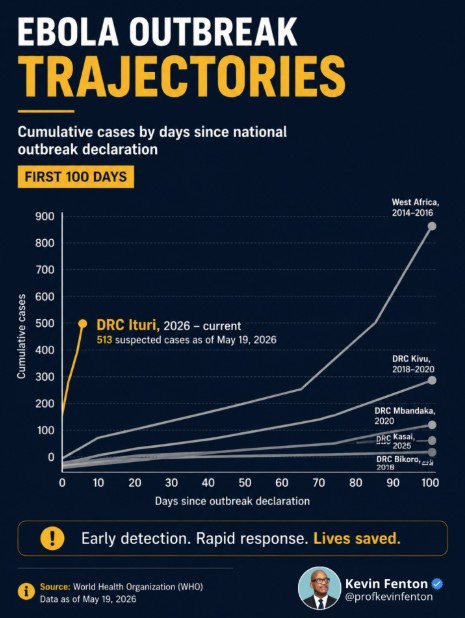
Since the graph above was made, another 100 cases have been diagnosed (as far as we know). And the number of individuals who have died from Ebola (that we know of) has increased to 139. The disease has likely been spreading throughout Africa for weeks (possibly months) undetected.
“Historically, USAID and the U.S. Centers for Disease Control and Prevention were the main players in supporting disease surveillance and response. The CDC has historically played a role in analyzing samples and lending their technical expertise. But on a press call Sunday, CDC Ebola response incident manager Satish Pillai said the U.S. was only informed about the outbreak last Thursday, a day before it was declared.
Typically, the U.S. would be in the loop sooner, and it’s unclear why there was a delay. But some experts pointed to the U.S.’s withdrawal from the WHO, and from providing foreign aid more generally, as a potential factor.”
Ebola will be with us for weeks (possibly months) to come. And the hantavirus quarantine countdown continues. Here’s what you need to know this week…
Hoping this post helps to educate and empower you
to be healthy and create healthy communities.
Hantavirus Outbreak Update
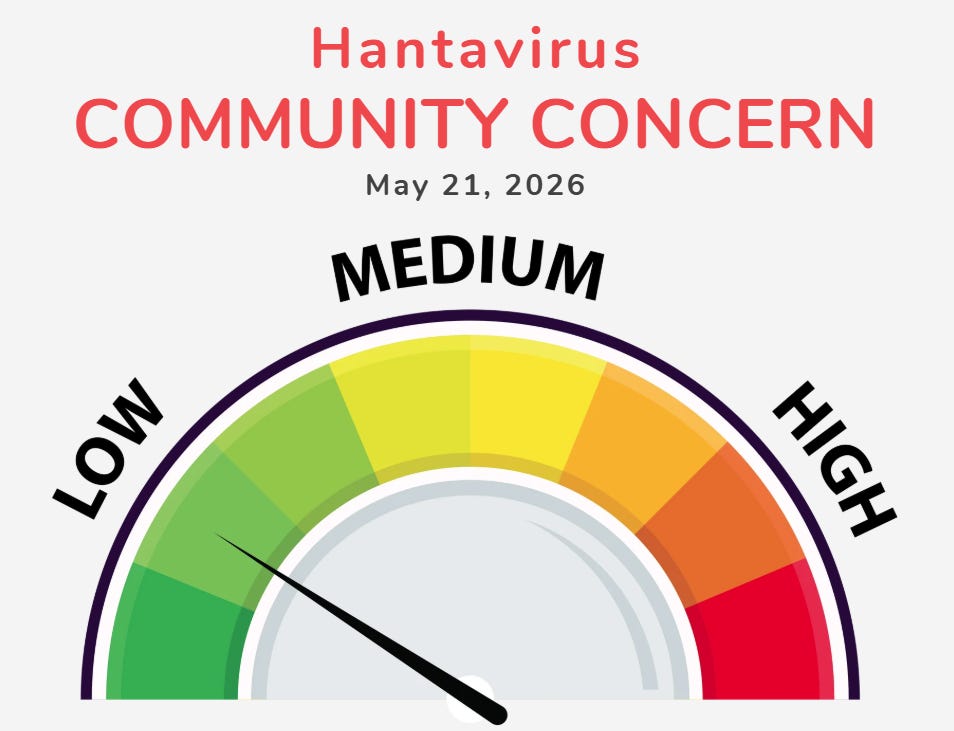
The hantavirus outbreak has been contained. Individuals who were on the MV Hondius are in quarantine and being monitored. Yesterday, the CDC confirmed that no additional Americans associated with the cruise have tested positive for hantavirus. The federal government has issued orders, signed by acting CDC Director Dr. Jay Bhattacharya, that require all individuals exposed on the cruise ship to quarantine at the Nebraska biocontainment unit; no one is allowed to quarantine at home (a huge change in policy).
And while more cases may be diagnosed over the next month or so, the hantavirus risk to the (general) public remains low.
Attempting to Control the Ebola Outbreak
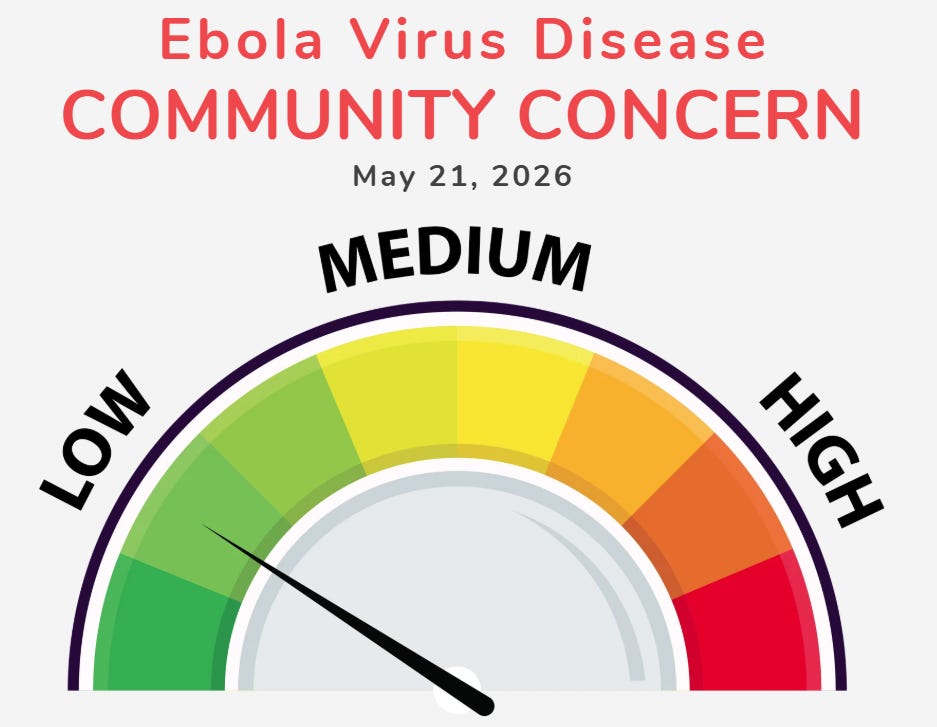
As mentioned previously, the number of cases and deaths from Ebola continues to increase. The Independent reports that the outbreak in the DRC is “very much not under control.” And the global public health community is waiting to confirm if the outbreak has spread to the city of Goma… If the disease is spreading in Goma, “It will not be easy to contain the epidemic in the city because the population does not readily adhere to preventative measures. The population is already traumatised by a multitude of problems. There are disasters all the time. War, volcanic eruptions, epidemics. Families, she adds, are hiding sick relatives at home out of fear and distrust. Pharmacies are already running short of soap, disinfectant, and masks.”
In response to the outbreak, the US government has implemented enhanced airport screenings. Beginning today, all US nationals and lawful permanent residents who have been in the Democratic Republic of the Congo (DRC), South Sudan, or Uganda in the past 21 days must travel through Washington-Dulles International Airport for enhanced Ebola screening.
Foreign nationals who have been in the DRC, South Sudan, or Uganda during the previous three weeks are NOT able to enter the United States at this time.
All travel restrictions are in place for (at least) 30 days.
According to the CDC —
“To date, no suspected, probable, or confirmed cases of Ebola have been reported in the United States, and the risk of Ebola domestically is low. However, public health entry screening is part of a layered approach that, when used with other public health measures already in place to detect symptomatic arriving travelers, can slow and reduce the spread of disease into the United States.”
Despite Ebola not being a risk here in the US right now, it is still a threat. This tweet caught my eye this afternoon.
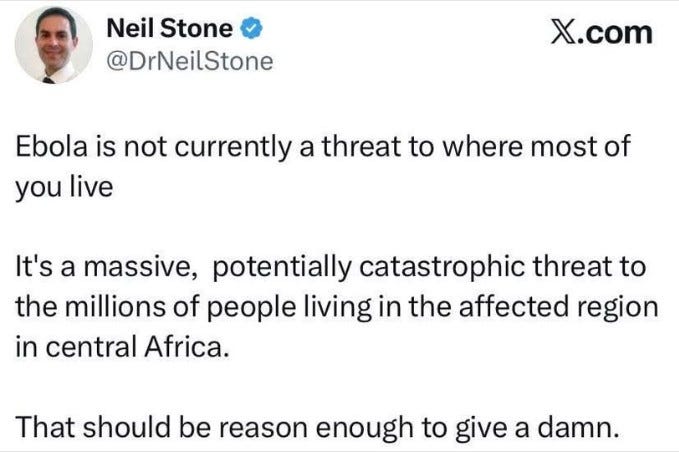
We should care about what is happening in Africa. And we should care about the millions of individuals who are going to bed tonight with a real threat of Ebola in their lives.
A health threat anywhere is a health threat everywhere.
We work to stop outbreaks in other places so that we don’t have to fight them here at home. We also do this work because it is the right and kind thing to do —
to care for others.
Mitigating Another Outbreak of Fearbola
During the 2014 Ebola outbreak, there was a simultaneous outbreak of fearbola, the collective panic, exaggerated anxiety, and mass media sensationalism regarding the virus, despite the actual risk of a domestic outbreak in countries like the U.S. being virtually zero.
This morning I woke up and saw this post —
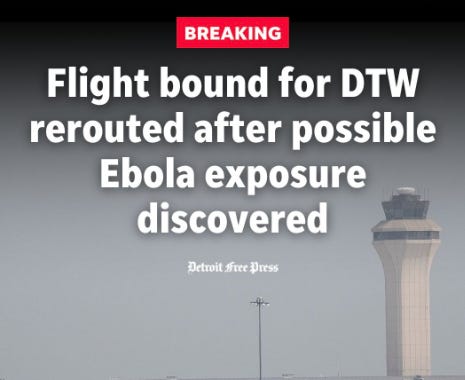
This headline is the beginning of a fearbola outbreak.
There was NO Ebola exposure discovered on the flight.
What happened? And why was the flight rerouted?
Quite simply, there was a passenger on board who should not have boarded. The flight was diverted for legal reasons, not because someone on board was sick or had a high-risk exposure.
It is REALLY important to understand what is happening on the ground in Africa and legally here in the United States. The travel bans in place for the next 30 days require all US nationals and lawful permanent residents who have been in the Democratic Republic of the Congo (DRC), South Sudan, or Uganda in the past 21 days to travel through Washington-Dulles International Airport for enhanced Ebola screening.
Foreign nationals who have been in the DRC, South Sudan, or Uganda during the previous three weeks are NOT able to enter the United States at this time.
If someone is placed or accidentally gets on the wrong flight, the flight will be diverted. It is the law. It does NOT mean that an “Ebola exposure (was) discovered.”
The risk of Ebola in the US is extremely low.
And we must all work to prevent an outbreak of fearbola.
Hoping this post helps to educate and empower you
to be healthy and create healthy communities.
Please, share this post with your friends and family.
And if you have any additional questions about hantavirus, please let me know.